No Products in the Cart

Inside Quintosapore: The Umbrian Farm Rebuilding Taste from the Soil Up
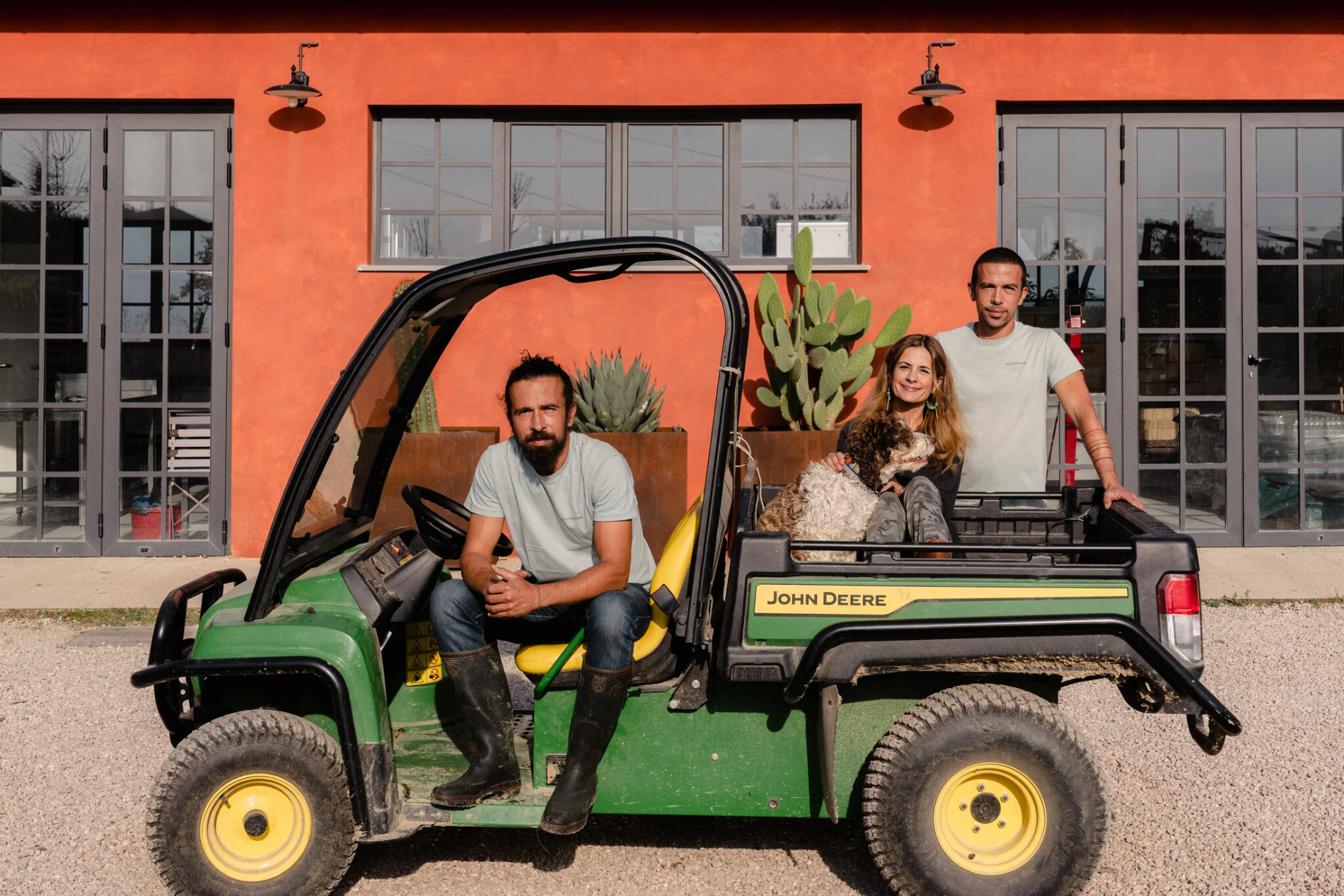
There are landscapes where time gathers differently, where the relationship between land and people is measured not in yield but in understanding. The farm known as Quintosapore sits in such a place, a hillside in Umbria shaped by soil, stone, woodland and three siblings who chose to learn from all three with uncommon patience. Alessandro and Nicola Giuggioli, along with their sister Livia Giuggioli Firth, arrived here without the inherited assurances of generational farming. What they brought instead was curiosity, and in the span of five years that curiosity has transformed a conventional plot of land into one of Italy's most thoughtful experiments in regenerative agriculture.
The origins of Quintosapore do not follow the familiar arc of rural revival. This was not a return to roots. It was a deliberate step toward a life the siblings had imagined but never inhabited. They purchased the farm with a sense that its potential lay in its quiet lessons. Watching the land closely became their first method. They noticed what survived heat, what yielded only when shaded, what grew without demand. They studied the rhythms of the nearby forest, which remained resilient through droughts that drained neighboring fields. That contrast became a catalyst. Much of what Quintosapore is today began with observing how nature organizes itself when left undisturbed.

Their approach could be called biomimicry, yet the word feels clinical for something that relies so heavily on attention. They pulled from regenerative farming, biodynamics, agroforestry and permaculture, not to perform an ideology but to develop a system that felt truthful to the land. It is a system built on complexity. Layers of vegetation, diversified root depths, cycles that allow the soil to repair itself, the presence of microorganisms that had long been depleted. The farm's evolution was less a pivot and more a steady accumulation of decisions rooted in what the land revealed.
Tomatoes became a kind of anchor in this process. In a country where tomatoes often become shorthand for cuisine, the Giuggiolis approached them less as symbols and more as a study in responsiveness. Their tomatoes differ from year to year because the land does. Their flavor is shaped by the heat of a given summer, the mineral conditions of the soil, the density of surrounding vegetation. These variations are not treated as imperfections but as evidence of the land's voice. It is the kind of agriculture that insists food must reflect the season that produced it, rather than a standard imposed upon it.

Sustainability at Quintosapore operates on several levels. Ecologically, it means rebuilding soil health, reducing inputs, avoiding tilling and minimizing waste. Socially, it means stable employment, full contracts, and a commitment to treating agricultural labor as skilled work rather than a disposable resource. Culturally, it means acknowledging the Italian inheritance that shapes the farm. Italy has a way of teaching through the table, through the slowness of shared meals, through the idea that nourishment is as much about the quality of ingredients as it is about the conditions in which they were grown. Quintosapore embraces this ethos without romanticizing it. It is Italy, but without the veneer. It is a working landscape, not a postcard.
The commitment to transparency at Quintosapore is not an aesthetic stance but a structural necessity. The farming practices, the employment model, the relationship to the land all depend on honesty. It is the only way the system holds. Livia and Nicola's background in environmental advocacy and sustainable business practices—particularly her work around traceability and ethical production in fashion and film—finds its natural extension here, though the farm doesn't perform its values so much as build them into structure. What they brought to industries known for opacity, the siblings bring to agriculture: the insistence that how something is made matters as much as what is made.

Quintosapore’s philosophy naturally shapes its educational work. The farm welcomes people into the daily rhythm of the land, offering a place where learning grows out of participation rather than observation. The siblings speak plainly about the strains in today’s food systems—the abundance that never reaches a table, the efficiency that erodes long-term resilience, the way global supply chains lose extraordinary amounts of food before it can nourish anyone. They frame local production as a grounded, sensible response to these realities, a way to rebuild connection and accountability. In their view, agriculture sits at the center of cultural life, revealing how a society feeds itself and how it chooses to live.
It was this combination of clarity and intention that drew DLISH to the farm. The collaboration between DLISH and Quintosapore was conceived as a way to interpret the land through objects and food. The first project produced the DLISH and Quintosapore Gourmet Salt Tasting Box, a curation that distilled the farm's flavors into a sensory experience. The salts carried the imprint of sun, herb, mineral and season, and the box presented them as fragments of a landscape.

A second collaboration followed with the Pumpkin Black Truffle Soup Gift Box with ceramic bowls. Unlike the salts, this box was built around warmth, around the earthiness of pumpkin and the depth of truffle, around the idea of a meal that holds you in stillness as the air gets colder. It revealed another side of the farm's work, one tied to comfort rather than sharpness, to the intimacy of a winter table.
The relationship between DLISH and Quintosapore continues to grow. Plans are underway for a Persian Caravan experience on the farm in June, a gathering shaped by cross-cultural storytelling and a shared belief that food can become the meeting point of histories. The collaboration draws on the historical resonance of spice routes and culinary exchange between Persia and the Mediterranean, traditions of hospitality that understood meals as occasions for encounter rather than transaction. The table at Quintosapore lends itself to this kind of exchange. It carries the weight of Italian tradition while leaving enough space for other narratives to settle.
Even from a distance, Quintosapore gives the sense of a future quietly forming. It is not the future promised by technological acceleration or industrial efficiency. It is slower, more deliberate, rooted in the idea that resilience is not built through extraction but through intelligence and reciprocity. The land at Quintosapore offers this lesson openly, and the siblings have built a life around receiving it.

The fifth taste, which gives the farm its name, is often described as depth. At Quintosapore, it becomes a way of understanding the world. It is the depth of soil restored through patient work. The depth of a tomato that tastes different each year because the land insists on being itself. The depth of a farming system built not to dominate nature but to participate in it. The depth of a table where stories gather as easily as meals.
Quintosapore is a recalibration of modernity. A reminder that the way we grow food is inseparable from the way we live. And perhaps that is its most compelling offering—a vision of agriculture that does not retreat into the past but moves forward with a kind of steady, grounded hope.

Visit Quintosapore to learn more about their regenerative farming methods and upcoming events.
Images courtesy of Quintosapore
